ERROR: Our system requires that you have cookies enable in order to work correctly. It appears that you have cookies disabled in your browser. Check your browser's help manual to find out how to enable cookies.
Kidney Recipients - National Kidney Registry - Facilitating Living Donor Transplants
There are over 150,000 people in the United States living active, full lives who
have received transplanted kidneys. Kidney transplants are truly a miracle of modern
medicine. If you are facing kidney failure and are medically qualified for a transplant,
we want you to have the miracle of a kidney transplant. If you have an incompatible
living donor or a poorly matched living donor, we exist to help you.
The first step in the process is to register with one of our participating transplant centers. If there is not a participating center in your area, ask the center that you are in if they will help you get a compatible kidney by working with the National Kidney Registry.
There are no fees for recipients and donors who are working with our participating centers.
If you have not yet decided where you want to have your transplant performed, we will provide you with relevant facts to help you select the transplant center that best meets your needs. You must select a transplant center and be evaluated by that center to ensure you are medically qualified for a transplant before you can participate in an exchange.
Now it is time to assemble your team and initiate your donor search. The search process is the most important aspect of getting a well-matched kidney and the most significant controllable factor in getting a great transplant outcome. Not all donor kidneys are compatible or well matched. A donor kidney that does not work well for you may be a perfect match for someone else and that other person’s donor could be a great match for you. This is the power of a kidney exchange.
The next step is to collect all the medical information you need to evaluate your potential donors (these donors may be direct donors or donors available through a kidney exchange). Your transplant center will help you with this process.
When you are cleared by your center and have at least one activated living donor, we will enter you in our BestMatch system and continuously monitor your donor options based on your preferences so that your transplant center can select your best option as soon as it becomes available.
Once you have a match, you will move forward with a transplant. This process includes several more “go no-go” check points. It is always possible that the potential donor you selected will not progress to transplant for a variety of reasons. If this happens, you want to have back-up donors, if possible.
Once the date for the transplant has been scheduled, you will need to immediately provide blood samples for a cross match test to insure your exchange donor is compatible. This test can be done in person or through the mail. This cross match test must be repeated one week prior to surgery. If all tests are passed and everything goes according to plan, you will receive your new kidney from your exchange donor at the same time your paired donor donates their kidney to an exchange recipient.
After you have completed the transplant surgery and have your new kidney, you must now take care of it. Block off the three months following your transplant to completely focus on the care of your new kidney.
The good news is that if you are facing kidney failure, a large part of achieving a
great outcome is under your control. You cannot choose the medical problem that caused
your kidney failure, but you can greatly improve your chances for the best possible
outcome if you are willing to fight for every advantage. Below are the key areas where
this fight takes place.
The first step is to make five critical decisions that will have a significant impact
on your transplant outcome. They include (1) choosing when to have the transplant; (2)
choosing to pursue a living donor or deceased donor transplant;(3) forming your donor
search team, recruiting donors, and selecting the donor; (4) selecting your medical team,
including the transplant center, the surgeon, and the transplant nephrologists; and
(5) ensuring that you are in the best physical and mental health throughout the process.
One of the first questions you must address is when to have the transplant. If you are
not on dialysis yet, the evidence indicates that you can improve your opportunity for
a successful outcome if you have a preemptive transplant and never go on dialysis. If
you are on dialysis, the evidence indicates that the faster you get a transplant,
the better the outcome. So don’t delay, act now.
If you have not done so already, you should sign up for Medicare Part A as soon
as possible. All persons who have end stage renal disease (i.e., kidney failure) are
generally covered by Medicare Part A. It does not cost you anything and it may cover
Kidney Registry Fees and the costs of finding the proper kidney for your transplant
surgery as well as laboratory and other tests needed to evaluate your medical condition
and the medical condition of potential kidney donors. If you have private insurance,
Medicare becomes the secondary payer for those costs not reimbursed by your private
insurance. Usually the social worker at your dialysis center or transplant center can
help you complete the applications.
Another important decision you must make is if you are going to try for a living
donor transplant or if you want to wait for a deceased donor kidney. In most cases, you
are best off to pursue both options simultaneously. Living donor kidneys have higher
success rates and last nearly twice as long as deceased donor kidneys. Additionally,
if you have a potential living donor, you will not need to wait the two to eight
years for a deceased donor kidney. But even if you have a potential living donor, you
should get listed in the deceased donor database as soon as possible so that you have
a fallback option and can start accumulating wait time points in case your potential
living donor search is not successful.
Graft Half Life
The Point In Time When Exactly 50% Of Transplanted Kidneys Are Still Functioning
Create a team for the donor search and transplant process. This team should include
an administrator, a caregiver, and one or more donor recruiters. In many cases, one
person may have more than one role. For example, a spouse may be the administrator
and the caregiver while the parents are the recruiters. It is best if the recipient
focuses on his/her mental and physical health prior to transplant and does not try
to take on these roles unless there is no one to fill the roles. The administrator
will manage all the insurance, medical records, and other paperwork, which must be
well organized. The caregiver will oversee the recipient’s medical needs. The
recruiter(s) will focus on finding donors for either direct donation or paired donation.
Choose your recruiters thoughtfully. The best recruiters will generally be people close
to the recipient who cannot donate because of health reasons or incompatibility. If they
are incompatible, it is helpful if they are willing to donate through a kidney exchange.
Have your recruiters start recruiting immediately. Keep a list of potential
donors. Focus on the potential donors who are healthy, committed, and may be willing
to enter into a paired exchange.
Do not convince yourself or tell anyone that you have a donor during the search
process. Until the surgery actually takes place, you only have potential donors.
There are many reasons that potential donors never become actual donors – medical and
otherwise. It may turn out that even though you have 10 potential donors, none of them
can donate.
Do not stop recruiting even if you have several potential donors and do not stop
recruiting until your potential donor has passed the final cross match test and surgery
is less than a week away.
If you are a recruiter, don’t be shy about asking people if they would
consider donating. Start with friends and family (siblings have the best chance of being
great matches) and build from there. Whenever you ask someone if they would consider
donating, regardless of their willingness to donate, follow up by asking if they know
of anyone who would be willing to donate. Seek out brave people. If someone is or was
in a courageous profession, such as law enforcement, the military, or fire fighting,
they are more likely to consider donating. These people also have many brave friends
who may be willing to donate even though they do not know the recipient.
It is generally best not to initially ask if someone will donate – people need
time to do the research and understand what it means to donate. Give potential donors
the Registry website as a starting point for this research. Instead of initially asking
if someone will donate, ask the potential donor if they would consider taking a blood
test to determine if they can donate. Some people say they will consider donating but
never follow through – expect this. Use the blood test as a screen to determine
whether someone is serious about donating.
Ideally, every potential donor who is willing to donate directly would also be
willing to donate through an exchange also. This is not always the case. Sometimes a
donor will be willing to donate directly but not through a paired exchange. You need
to determine this at the appropriate time in the recruiting process.
Donors who are willing to enter into a kidney exchange are powerful because they do
not need to be blood compatible or pass a cross match test with you. These donors are
extraordinary because they can expose the recipient to hundreds of potential donors
that are in the many exchange programs in the United States. The more donors you can
be exposed to through an exchange, the greater the opportunity for an excellent match.
Not all potential kidney exchange donors are equal in effectiveness in paired
exchanges. The most powerful exchange donors have the following characteristics:
They have “O” blood type (universal donors)
They are young (ages 18 – 35)
They have no travel restrictions
They do not require financial aid to cover donor expenses
Select the best donor. Consult with your nephrologists and/or your surgeon in making
this decision. Some important factors include:
What is your antigen match with the donor?
What is the age of the donor?
How powerful is the donor’s kidney?
How committed is the potential donor?
How healthy is the donor?
Antigen matching is one of the most important variables when considering what kidney
is the best match for the recipient. The highest match is a 6 antigen match and the
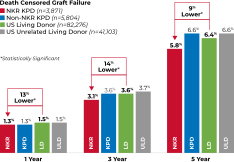
lowest match is a 0. Every antigen that you match counts – see the charts below.
Not only does a high antigen match provide for a better outcome on the first
transplant but it reduces the number of antibodies that the recipient will field,
which will influence the probability of cross match failures in a second or third
transplant. Because a recipient cannot produce antibodies against antigens that it has,
the more antigens the recipient matches on, the fewer antibodies that are created. Fewer
antibodies are good because the more antibodies someone has, or the more sensitized
they are, the fewer potential donors that will pass the cross match test.
Avoid sensitization events, if possible, and redo your blood test after any
sensitization event. Sensitization events include transplants, blood transfusions,
and pregnancies. Sensitization events create antibodies and make it harder for people
to pass the cross match test.
When you set your recipient preferences with the Registry, place as few restrictions
as possible in your profile and provide the maximum amount of financial aid you can
afford in the form of a restricted charitable donation to the Registry to help cover
donor-related expenses (e.g., travel, lodging, meals, and lost wages) in the case that
the donor you are matched with cannot cover these costs. These charitable donations
are tax-deductible.
Select your medical team carefully. We can provide you with the relevant facts
to assist you in evaluating your options. Your medical team will have an impact on
getting a great outcome and should consist of a transplant nephrologist, a surgeon,
and the transplant center where you will receive your new kidney. When selecting your
medical team, you must consider the track record of the team as well as the proximity
to your home. You will be going back and forth a lot and you may need to get to your
team fast if you have complications. If you choose a center that is far from your
home, you may consider renting a place to live for one to three months following the
transplant to ensure quick access to your team.
When selecting your medical team, you want to visit the website of the
Scientific Registry of Transplant Recipients
to review the track record of the centers you are considering.
On this site, click on the state where you want to get your transplant, click on “Kidney
Centers,” and then select the transplant center that you want to view. At the top
of this page, use the drop-down menu to select report 10, “Graft Survival after
Transplant by Donor Type,” to review this center’s track record compared
to regional and national data.
After your surgery, you must absolutely take your medications as directed. If you
end up back in the hospital for post-operative complications, take your medications
with you to the hospital. Never blindly trust anyone, including the hospital staff, to
give you your medications. They sometimes make mistakes. Just as getting a well-matched
living donor is the most important controllable factor for a great transplant outcome,
taking your medications accurately and on time after getting your new kidney is the
most important post-transplant factor for sustaining that great outcome.
You may need to rush back to the hospital and check into the emergency room if you
have complications, so keep a bag packed and by the door. Be prepared to leave at any
moment. If the results from your routine blood tests come back with abnormalities,
you want to be able to get to the emergency room quickly.
If you need to return to the hospital because of complications, ask your surgeon or
nephrologist to meet you in the emergency room. This will save you time and allow you
to avoid potential mistakes made by other medical professionals who are not familiar
with your situation.
Taking all the different medications after surgery can be a complex and challenging
task. You may want to consider getting a pillbox with an alarm on it for assistance
in taking your medications. The following website offers a variety of pillbox alarm
systems www.epill.com.
Finally, stay healthy and maintain a positive mental attitude. If you are overweight,
take the opportunity now to lose the extra weight. Make sure you eat right, exercise,
and get enough sleep. If you have other health problems, follow your doctor’s
instructions. Think of the transplant as an athletic event for which you must prepare
in advance for a great performance. Much of the outcome is under your control, so stay
focused and you will achieve a great outcome.